Existentialism
lecture, letter & thoughts

I published i need an elderly to teach me life, and waited to see whether anyone would understand what I was actually doing, or intending to do with the piece. Whether the essay would be received as what it was, or flattened into what is easier to hold. The least I wanted, was are you okay. Now, I find myself with the urge to explain what that essay was—and what it wasn’t.
Certainly, it wasn’t therapy, or a depressive mood dressed up as pretty sentences and prose. It wasn’t trauma dumping, oversharing, or any of the other words we reach for when someone says something true in public, and we don’t know where to put it. I wanted to create art, as a witness. It was me trying to say this is what the inside of a human mind looks like—yours probably looks similar, and you’re allowed to know that. Now, I invite you to set the right scene with me, and expose what was always underneath.

Imagine a grey Tuesday.
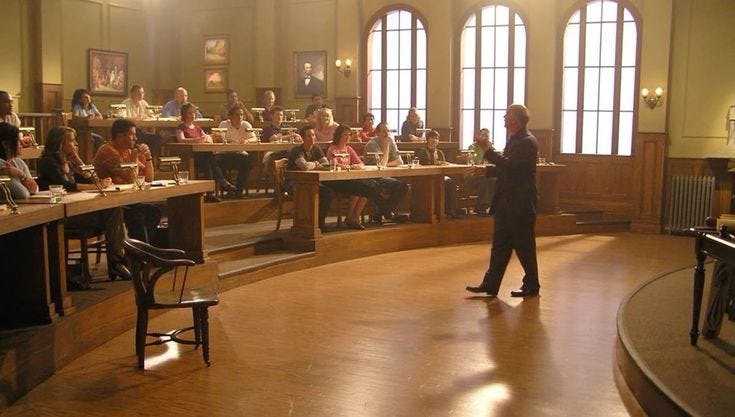
A morning where the rain hasn’t decided yet—the sky the colour of old paper, the air carrying a certain cold that lives specifically in university corridors. You are sitting in a lecture hall, the wooden kind, with tiered seats and windows that rattle slightly when the wind picks up. Your coat is still on. There is coffee, still hot, right beside you. Your professor stands at the front of the room. They have just read the essay aloud to the class—the prose, the words, the four most frightened ones—and they set the pages down and look out at the room and ask the following question:
“In the piece before you, four words arrive without warning and disappear just as quickly. “I’m the problem”. No elaboration, no defence, no retraction. There is this kind of self-awareness that looks identical to self-punishment from the outside. Perhaps from the inside too. When we name ourselves the problem—is that clarity, or is it the oldest wound speaking? Write into this. The best essays will not conclude, they will arrive somewhere unexpected—and stop.”
On writing darkness without apologising for it
I want to begin with something that bothers me. We say we want realness. We say we are tired of curated lives and highlight reels and the exhausting performance of okayness. We say we want to see the full human—messy, contradictory, unresolved. And then someone are seen crying, or writes something raw and unpolished and true—and the response arrives immediately, reflexively, almost before the thought has formed: “why would they do that. what a crybaby. are they okay?”
We crave realness the way we want cold water on a hot day. In theory, it’s refreshing, until it actually touches us and we recoil. I wrote “i need an elderly to teach me life” inside this contradiction. I knew it existed. I wrote into it anyway, because I think the contradiction itself is worth examining as something deeply philosophical, old, and human.
The piece moves through several philosophical traditions, most of them unintentionally intentional. I did not sit down, and think or ponder. It just happened to become a Jungian essay with existentialist undertones. I sat down, following a certain flow, with the particular loneliness that isn’t sadness—more like sitting with the full weight of being conscious. And I wrote down what came before, during, and after.
However, the traditions arrived anyway, because they are where honest thinking leads.
There is existentialism in the opening question—”what is all this for”. Nothing rhetorical. It is Sartrean. The confrontation with meaninglessness, the weight of radical consciousness, the refusal to look away from the fact that we are here, aware, and largely without instruction. I did not resolve it. Sartre didn’t either.
There is Jung in the insistence on facing the shadow—the darkness we carry, the shame we hide, the parts of ourselves we bury because they are inconvenient or ugly or frightening. Jung believes the path to wholeness ran directly through the shadow, not around it. I arrived at this conclusion not through Jung but through living. That is, I think, how most people arrive at it.
Then, there is impermanence—Buddhist, though I did not name it—in the nature passages. The shedding, the cycles. The acceptance that we die in order to bloom again, and that this is not tragedy but the most fundamental truth of being.
And threading through everything, high sensitivity as a way of knowing. The Romantic philosophers understood this. Keats called it negative capability, the ability to remain inside uncertainty without grasping for resolution. To feel everything and not be destroyed by it, but to let it become the very instrument through which you understand the world. I wrote this piece as an argument—unwanted, unannounced, but an argument nonetheless—that sensitivity is not weakness. It is epistemology. It is a particular way of knowing that the world needs more of, not less.
But here is the thing I want you to understand the most.
The hero’s journey, as we have agreed to tell it, only begins after the story is over. We wait for survival. We wait for the lesson, the growth, the redemption arc, the moment the protagonist can look back and say ”that was hard, but look who I became.” And then we allow the darkness. Retrospective darkness and struggle is safe. Inspiring. It has already been survived. It comes with the implicit reassurance that the person telling it is okay now.
I am not interested in retrospective darkness (at least for this current matter here).
I am interested in the middle of it. The living of it. The cold tea and the fast-beating heart and the “i’m the problem” sitting alone on its line with no explanation attached. Not because I want to frighten you, or because I am unwell, or because I have confused my journal with Substack. But solely because that is where the most honest writing, and being, lives. And because you have been there too. You are there now, perhaps, or you were last Tuesday, or you will be next month. And the story you have been told—that darkness is something to be survived quietly and shared only after, cleaned up, with a lesson—is a story that keeps you alone inside it.
I wrote this piece to keep you company in the middle. And to explore what it means to showcase vulnerability—in a different setting, form, and way. I wrote it to say: yours is allowed to exist too. You do not have to wait until you are okay to be seen.
Love,
Sevval
Thank you for reading this piece. If you enjoyed what you’ve read, consider supporting this blog by becoming a free or paid subscriber.