

Surrender
The quiet home of yourself

There are mornings when I wish I could press a finger to the clock and make it stop. When the light falls just right through the window, when the tea is still warm, when the world outside hasn’t yet remembered that I exist. I want to stay there, suspended inside that small and carefully curated quiet. Almost invisible, really. A bubble—thin-walled and beautiful and entirely mine.
However, I’ve learned that peace is not something you can cage. It’s a passing thing, like weather or light on water. Life will find you regardless. It will move through you the way wind moves dry leaves: carrying you somewhere you didn’t plan on going, depositing you somewhere unfamiliar and asking you to call it home. And so the question becomes not how to hold peace still, but how to carry it inside you while everything moves.
I have been thinking a lot about the particular kind of courage it takes to detach. Not the cold, hard detachment of someone who has stopped caring, but something softer. Something that looks, from the outside (or inside), almost like letting go of a breath you didn’t realise you’d been holding.
There is, I’d like to believe, a right way to step back from the noise of the world, from society’s relentless appetite, from other people’s expectations, from the performance of work and productivity and achievement. A way that is not rooted in bitterness or exhaustion or the desire to disappear. But in something closer to clarity. Something more calm. Something that feels, once you find it, less like retreat and more like arrival.
The irony, of course, is that when you step away from the world in this way—gently, deliberately, without resentment—you begin to feel more connected than you ever have. Connected to yourself, first. And then, slowly, to everything else.
I think artists know this feeling intimately, and can find themselves in this sense of duality. There is a particular moment in the making of something—a painting, a poem, a song—when you have to release it. When you have to stop being the author and allow the work to become something that belongs to whoever finds it. You detach from your own meaning so that others can pour theirs in. It’s one of the bravest, most intimate and generous things a person can do: to create something and then let it go.
We are all, in some way, trying to do this with our lives.
The world is loud about what you should want. It has always been loud about this, triggering quiet resistance of feeling alone. Yet, there is a kind of dignified surrender that asks nothing of anyone. It does not require an audience. It does not need to be explained or defended or understood. You can release yourself from what you thought you had to be without making a ceremony of it. We are allowed to do this. We are allowed to lay something down simply because it is heavy.
The limits that have been places on us—by others, by circumstances, by the smaller, more frightened versions of ourselves—are not the truth. They never were. They are stories, cold and old ones at that. Stories told to us before we were old enough to know we could refuse them. But we are old enough now. And the refusal, when it comes, doesn’t have to be violent. It can be the quietest (or loudest) thing: a choice, made by yourself, to stop believing what no longer serves you.
Be so rooted in yourself that when those old stories come (and they will come, carried on the mouths of people who mean well and people who don’t) they simply pass through you. It’s not a manifestation that you have hardened, but proof you are finally grounded enough to let them move.
And then there is the pain. The kind you have been carrying so long it has begun to feel like a part of you. Like a room in the house of yourself that you have simply stopped entering. You’ve learned to walk around it. You know which floorboards creek, and which floors to avoid.
It takes a tremendous amount of courage to open that door. Because the pain that has carried you through your life has also protected you—and it is a strange and disorienting grief to let go of the very thing that kept you standing.
We are peculiar in this way. We spend so much of our lives trying to avoid the one thing that makes us most alive: feeling.
We build elaborate structures around our softness—distraction, achievement, numbness, noise—and we call it coping. But the numbness is not selective. When you close the door on pain, you close it on joy as well. You close it in wonder. On longing. On the particular sweetness of being moved by something small, utterly mundane. That is why, perhaps, you sometimes feel nothing at all, even in moments that should feel like everything.
To feel is not weakness. It is the most human thing there is. And one of the most radical acts of self-love is to stop treating your own depth as a problem to society, or yourself.
I want to tell you something about the people who have judged you. Who have looked at your life and found it wanting, or strange, or too much, or not enough. They were not seeing you. They never were. They were seeing their own pain, refracted through the lens of your existence. Their certainty about who you should be is a map of their own unfinished grief—not a verdict on yours.
This is a hard thing to hold. Because we want the people who love us to see us clearly. And sometimes, they cannot—not yet—because they have not yet learned to see themselves. But once you understand this distinction, once it settles into you like something you have always known but forgotten, something shifts. A weight you did not know you were carrying begins, very slowly, to lift.
And this is also where the tenderness comes in. People are not always villains. They are simply people who were never given permission to feel their own pain. They passed it on the only way they knew how—quietly, without knowing, the way all inherited things are passed: through proximity, through example, through the silent architecture of childhood.
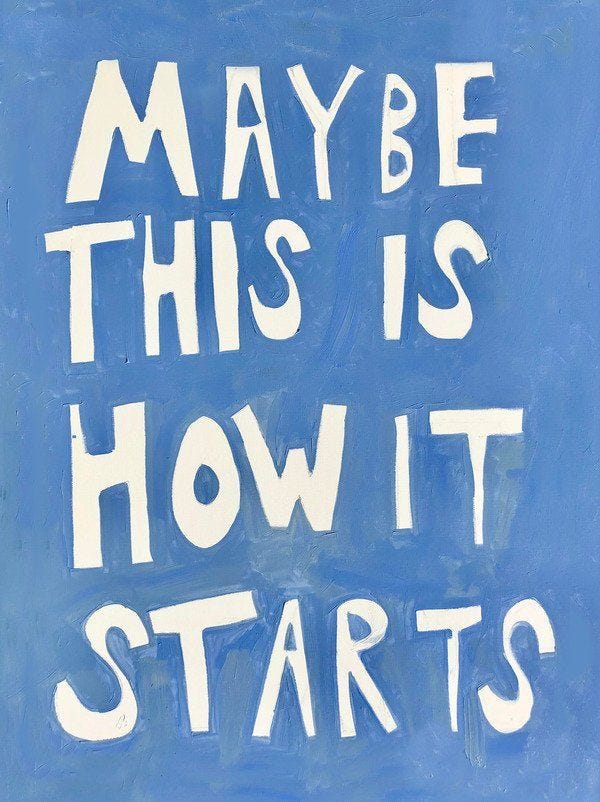
You must not give up. I say this without drama, or platitude. I say it the way I would say it to someone sitting beside me in a quiet room: you must not give up. There will be days when the dark is not poetic. When it is just heavy, grey, and without a visible end. On such days, the light you’re being asked to trust will feel very far away. But have you ever noticed how beautiful the dark grey sky contrasts the blue on a stormy day? The way thunder illuminates the above for a second, greeting the moon as it passes? The dark is where things root. It is where the growth happens that you will only understand in retrospect, standing somewhere warmer, looking back with something like gratitude at the passage you survived.
There are a thousand reasons to stop. I know. But there are a million more reasons not to. I am asking you to find them—to name them, to write them down if you need to, to place them somewhere you will see them in the morning when the light is still low and the world hasn’t asked anything of you yet. Hold them. Return to them. Do not let yourself forget.
We are all living for the first and only time. Every single one of us—stumbling through, trying to make sense of what we’ve been given. There is something deeply ordinary about this, and something deeply sacred. We feel things too intensely and not enough, all at once. We love badly and beautifully. We disappoint and are disappointed. We forget, and then we remember.
Do not, under any circumstances, allow someone to make you feel small for this. Depth is not a burden. Sensitivity is not a flaw. We’re not too much. We are, in fact, exactly what the world needs more of—someone willing to feel it all and keep going anyway.
So heal yourself—not so you can be fixed, but so you can be free. And when you are, reach back. The person behind you on this path needs to know someone walked it first.
Don’t you think we deserve a good life?

Oh my goodness, Sevval. This was truly beautiful. I can’t quite believe that you’ve put my thoughts into actual words! You’re such a talented writer 💞🌞